
Watching the Skies

The US National Weather Service has a lot of weather to watch! They have sensors all over the continent, and in space, ranging from simple thermometers to orbiting satellites. When weather happens (and let’s be honest, weather is always happening, it’s happening on me right now) it happens fast — how does the NWS take in the whole situation at a glance and make decisions? On a map, of course.

The NWS Central Region Headquarters has built a test-bed for putting their situational information onto web maps, and the toolset they used is the OpenGeo suite of applications: PostGIS, Geoserver, OpenLayers. They also used raster-data standby GDAL for handling gridded data conversions.

Convective Situational Awareness in the Upper Mississippi

A paper on their work (”Development of Web-based GIS Applications for Decision Support and Situational Awareness“) was presented by Brian Walawender at the  American Meteorological Association Annual Meeting this week.

Cities Powered by Open Source

San Francisco recently established a new policy requiring open source software to be considered equally with commercial software within the city’s procurement process. It’s important to note the actual inclusion of the word “equal” in this policy. Emphasis here is mine:

The Software Evaluation Policy will require departments to consider open source alternatives, when available, on an equal basis to commercial software, as these may reduce cost and speed the time needed to bring software applications to production.

San Francisco Open Source Policy

This is much like the legislation passed in Vancouver last May:

Open Source Software – the City of Vancouver, when replacing existing software or considering new applications, will place open source software on an equal footing with commercial systems during procurement cycles;

Vancouver Open Source & Open Data Policy

Back in September, I think Portland actually initiated the “First-In-Nation Open Source Software Policy for City Government,” but the language in Portland’s resolution is definitely not as strong:

Establish best practices for analysis of business requirements in software review and selection processes, identify existing commercial software systems with licenses that are scheduled to expire in the near future, and encourage the consideration of Open Source Software in the review, replacement and continual improvement of business solutions;

Portland Open Source & Open Data Policy

Portland’s resolution should be amended from “encourage the consideration” to “require equal consideration” and other cities should make sure that they provide measurable policies for using Open Source rather than simply to “encourage consideration.”

These developments are huge and these cities deserve to be lauded as great pioneers, but we also need to help support them and to spread these kinds of policies to other cities. You can learn more and contribute to the creation of resources for open cities with the nascent OpenMuni project.

Streetsblog San Francisco shows its political clout!

Every day at Streetsblog San Francisco, our writers and editors marvel at the intelligence and passion of our readership, though we rarely get to meet this community of dedicated urbanists in person. Recently we threw ourselves a birthday party at the LGBT Center in San Francisco to celebrate all that has come in one year and we were joined by 150 of our closest friends and avid readers. We broke bread and raised our glasses in honor of the impact that our brand of advocacy journalism has had on the Bay Area, where Streetsblog San Francisco has quickly become the go-to source for sustainable transportation and smart growth news. The event even became a stop on the campaign trail for current Board of Supervisors candidates intent on pressing palms with some of the smartest and most passionate of their constituents.

Special thanks to Jonathan Weiner, without whom this past year would have been impossible. Thanks also to Katie Brodie and Nico Martin Presents for the great crew of smiling servers, impressive spread and delicious mash potatoes bar (which was quite the hit), B-Haul for the (Tasty) tunes, super volunteer Denyse Trepanier, the LGBT Center, Swirl Wine Bar, SFBC and its volunteers for weathering the rain to provide valet bike parking, Supervisor David Chiu, Supervisor Eric Mar, Judson True, Leah Shahum, Andy Thornley, Gabriel Metcalf, Chris Carlsson, Dave Snyder, John Hamilton (for the great Streetfilm you see above), Mike and Sarah Sonn, Brooke Dubose, Greg Riessen, Gary Fisher, and many, many more...

Here's to a wonderful 2010 and many more reasons to celebrate the San Francisco Bay Area and its improving public realm.

One point Oh

This week, OpenGeo released version 1.0 of our OpenGeo Suite.

When we initially announced the OpenGeo Suite, it was a notion — a collection of individual software pieces we would professionally support as a whole. Now, it’s a product in the conventional sense — one download that provides all the pieces in a simple installer for Windows, Mac, or Linux:

  • GeoServer — a geospatial data and map server;
  • GeoWebCache — a map accelerator;
  • OpenLayers/GeoExt — user interface libraries for building map applications;
  • (New!) GeoExplorer — a browser-based map composer and publisher;
  • (New!) Styler — a WYSIWIG editor for map styles (SLD);
  • (New!) Recipe Book — code samples and documentation for building your own map applications;
  • Full documentation for all components; and
  • (New!) Dashboard — a unified administration panel for starting and managing the components of the OpenGeo Suite.

Up to this point, we have concentrated on clients already adept at downloading, integrating, and using the pieces of the Suite. With version 1.0, anybody can start publishing their data and building applications right out of the box.

This ease of entry aligns with the OpenGeo mission.  As an organization, we want to democratize mapping. That means offering tools available under non-discriminatory legal terms, like open source. It also means lowering barriers so that more people can use, build, and grow these tools.

Both novice and expert benefit from the seamless integration of the OpenGeo Suite.  By placing everything together in one place — software, documentation, examples, administration — the Suite offers a central resource to navigate, configure, and support the various pieces of your mapping application.

At a decision making level, we provide a corporate entity tightly bound to the software, providing support, expertise and training services to the community of users and administrators.

Version 1.0 is the first step in a long journey, but we know where we are going. Every day we ask ourselves: can we make our product easier to use? can we make it easier to learn? can we make it easier to try? We would love your feedback, so download the free 30 day trial and let us know what you think!

We’re looking forward to an exciting 2010, meeting those goals and growing our community.

News Round Up

Worthy news all around the TOPP-sphere this week:

  • Streetsblog and TOPP Labs are both talking about the MTA's move to open up transit data on their new website. On the heels of this announcement, we're hosting the next meeting of the NYC Open Transit Data Meetup on January 20th.
  • As the extent of the heartbreaking disaster in Haiti unfolds, Philip Ashlock has an excellent overview of open issue-reporting systems, with an eye on how they can impact disaster relief efforts.
  • In partnership with the World Bank, OpenGeo launched GeoNode.org. The GeoNode project is taking the principles and practices of openness which have empowered the modern web, and using them to build a spatial data infrastructure solution appropriate for large NGO’s and government agencies. Announcement here.
  • Streetsblog got a hat-tip in the New York Times for its coverage of Manhattan district attorney's decision to review the case of a former Police Commissioner who backed his SUV into a pregnant woman.

Redesigned MTA website and more coming Wednesday

The quest for open transit data in New York continues, but the Times’ coverage today of the upcoming launch of the MTA’s new website gives cause to be optimistic. As the Times reports, the MTA is set to launch a redesign of its website this Wednesday, giving the agency’s site a much needed — and appreciated — overhaul. The overall design of the site looks to be greatly improved, and the subway service status on the front page is alone reason to celebrate, as anyone who’s been bitten by weekend service changes will surely understand.

Another welcome change is the addition of the trip planner to the front page. Interestingly, the default option now uses Google’s transit planner, though the screenshots reveal that you’ll also be able to plan trips using either Trips 1-2-3 or the in-house MTA trip planner.

The most exciting part for open data geeks though is this promising morsel:

The new site will also make it easier for outside software designers to get free access to system timetables and routes.

The article contains no further information about what this means, though the screenshot does show a “Developer Resources” link on the lower right-hand corner of the page.

The MTA has hinted for a while at changes to its developer and licensing policies, but beyond the cessation of legal threats last August, there’s been virtually no public announcements on the topic. Many people, including those of us here at TOPP who founded the NY Open Transit Data group, have long advocated and worked to open up New York’s transit data. We’ve had increasingly positive interactions with the MTA, particularly since the arrival of chairman and CEO Jay Walder last October, but are still waiting to see results.

It’s unlikely that the launch on Wednesday will be perfect, but I think it will prove to be a significant step toward the goal so many of us share: universal access to free, complete, and up-to-date transit data for New York.

It looks like it’s going to be a good week for open data.

Job Opening: OpenGeo Systems Administrator

Our OpenGeo division is on the hunt for a talented systems administrator to help develop their suite of open source geospatial solutions.

The OpenGeo team develops spatial web services based on Java and clients in JavaScript. Our primary technology stack consists of Linux, Postgresql with a spatial extension, Jetty or Tomcat to run our servlets. We use webservers for static content and proxying. Additionally, we provide a few services to the projects we are involved in, such as Trac, Wordpress, and build bots for automated testing. A system administrator dedicated to this team provides a platform for running these services, as well as a supporting role for a team of 9 highly dedicated software developers and outreach engineers. There may also be some consulting work for clients, either to avoid scalability issues or to help debug problems on production servers.

The position provides you with the chance to design the infrastructure that you think is best suited to get the job done. A good candidate should therefore be analytical, self-driven and able to handle multiple tasks. We emphasize understanding fundamental concepts and being able to find more information, as opposed to experience with advanced tools. For instance, you should be familiar with /proc and the various tools used to extract information from this resource, as well as manually query HTTP based services.

Full job description..

Wanted: Volunteer Web Developer for NYC Parks Project

pentales

The Open Planning Project is partnering with the PenTales Storytelling Projects to develop an interactive web app for the New York City Department of Parks and Recreation. The application will serve as an interactive platform for New Yorkers of all ages to share and collaborate on stories they have produced through hand-writing, digital-writing, photography, moving pictures, voice media and other forms of communication. The platform will first pilot in New York City and will later be expanded to include other American urban and rural communities.

PenTales is seeking a talented, civic-minded volunteer developer to make the project happen. The developer will work very closely with PenTales and NYC Department of Parks and Recreation staff from start to finish, with guidance from TOPP’s developers.

The app will be built using the python-based open source Community Almanac code base. This same code is also being actively developed with other projects.

You can view the full job description on our jobs page. Please pass it on!

Fans & Advocates Select their favorite Streetfilms!

For the end of this year, Streetfilms decided to do something fun: ask some of the most influential livable streets advocates, personalities, journalists and web folk which of the 90 films we produced this year impacted them most.  Since we hit our millionth visitor this week and have recorded close to 2.5 million videos plays - hurrah! - it was a way to pat ourselves on the back, but also a unique way to review the year that was 2009 and let new fans know what they may have missed.

The choices were extremely diverse (only a few films got multiple mentions) which frankly surprised us. It would seem the popularity of some films, didn't necessarily make them the most popular in the minds of our voters.  Thanks to all the picks.  Hopefully we can make lots more in 2010, have a Happy New Year!

Janette Sadik-Khan (NYC DOT Commissioner): "It’s so hard, like choosing what to pick at my favorite chocolate store!  I'd select: The Search for the Zozo, Walk21, and Sands Street."

Brian Lehrer & Derek Tutschulte (The Brian Lehrer Show):  "The High Bridge gave us all a unique behind the scenes view of a New York treasure that few people ever get to see."

Jeff Mapes (author, Pedaling Revolution): "I like Rush Hour on the Hawthorne Bridge the best.  You so nicely captured the feel of something I know a lot about, having biked over that bridge in rush hour literally hundreds of times."

Laura Flanders (GRITtv): "For best series, the Brazil trilogy (ASCOBIKE, Curitiba's BRT, Jaime Lerner) was wonderful, [but] best one off: Scraper Bikes: Bike 4 Life Ride. Kids creating positive subculture, biking, and hip hop?  This was just great."

Mikael Colville-Andersen (Copenhagen Cycle Chic):  Carmageddon Averted in Herald Square.  "This film is great because of the enormity of the transformation and the visionary thoughts behind doing it."

Donald Shoup (professor, author "The High Cost of Free Parking"): "I vote for Bicycle Boulevards for NYC.  They seem like the most cost effective way for cities to make cycling easier, safer, and more enjoyable."

Diana Lind (Editor-in-chief, Next American City): "The video of a snowy Highline...it is real reminder of the New York that once was - and potential for any urban space to be reimaganied."

Gil Peñalosa (Executive Director, Walk & Bike for Life): "If an image is worth a thousand words, the Streetfilms site is worth billions. NYC DOT Explains Bike Lanes in the Big Apple shows that one size does not fit all [when it comes to bike facilities]."

Christine Berthet (über activist, Hell's Kitchen): "Veronica Moss in Times Square. She's just too much!"

Michael Graham Richard (editor Cars & TransportationTreeghugger): "Copenhagen's Climate-Friendly, Bike-Friendly Streets.  The bike capital of the world can teach us a lot about how we can make our cities much better for people and the environment. Let's pay attention."

Kerri Martin (founder, Second Life Bikes): "I love that Streetfilms takes us to places like  The High Bridge: a gem of a walkway in our corner of the world that most of us have never been on but can dream for its opening and help work towards that possibility."

Elly Blue (Managing Editor, BikePortland): "My favorite shows Mark Gorton wading out into embattled crosswalks yelling 'How rude! Can you believe these people?' Way to point out that the 300lb moonwalking bear in the room has no clothes."

Eric Britton (and the World Streets team): "Ahem. Let me open the envelope here....the Gold goes to: Meet Veronica Moss, A.U.T.O. Lobbyist.  For sheer thoughtfulness and political daring, the Silver goes to: Jaime Lerner on Making Curitiba's First Pedestrian Street.  And on the grounds that no one but no one can resist him: Enrique Peñalosa Brings Inspiration to Boston gets the Bronze.

Carla Saulter (columnist, Bus Chick, Transit Authority): "Scraper Bikes. I have a secret weakness for macked out cars--candy paint, big wheels, hydraulics, the whole nine - and I love seeing this same energy directed at a form of travel I can actually respect.

Ben Fried (Editor, NYC Streetsblog): "Hudson River Crossings: Improving Bus Capacity. Captivating animation and stellar narration bring an under-appreciated congestion busting solution to life."

Jackie Douglas (Director, Livable Streets Alliance (Boston): "The Search for the Zozo. Creative, funny, and an exceptional cast of people working to create more livable streets around the world."

Shin-pei Tsay (Deputy Director, Transportation Alternatives) "There's no better way to see how far we've come in such a short time than to witness people, let alone the founder of the Congressional Bike Caucus, Earl Blumenauer, happily and safely bike around NYC."

Clarence Eckerson Jr. (Director, Streetfilms): "The Transformation of Madison Square.  I really didn't want to pick one of my own, but I so loved being there on a balmy February. I tried hard to translate that energy."

Robin Urban Smith (Associate, Streetfilms): "Seattle's Bus Chick. I love the personal and charming story of this bus enthusiast. I'm also a sucker for the bus graphics!

If you want to leave your own personal pick for favorite Streetfilm of 2009 please do so in the comments field.  And if you have suggestions for places we should visit or subjects to tackle next year, feel free to start a list.

Living Plans

At last night’s PlanningTech workshop, we diagrammed out planning processes to see where the insertion of technology might have been helpful.  The processes we looked at ranged from seemingly simple (getting a bike rack installed on your street) to massively complex (advocating for funding for MTA’s capital plan). Keep an eye out for digitized versions of the diagrams, as well as the opportunity to help expand them.

One idea that stood out, and that solicited some good discussion, was the notion of a “living plan” — a planning document that, rather than being static and falling out-of-date quickly, would evolve as a community’s context, needs, and priorities evolved.  Of course, such a plan would be unthinkable in an analog world, and seems  ridiculously obvious in a wikipedia world.

But that’s not to say it would be easy to implement.  Last night’s group raised a handful of questions, including: “what about dealing with large, complex expensive projects? (e.g., transit expansion)” and “what about blowback from early participants when the plan changes over time?”, and “what about ‘planning fatigue?’”.  All important questions to ask, and I won’t try to answer them here.  But the gist of the idea was that given a set of guiding principles (a constitution, if you will), a “living plan” might allow for more flexible planning and easier decisionmaking down the line.

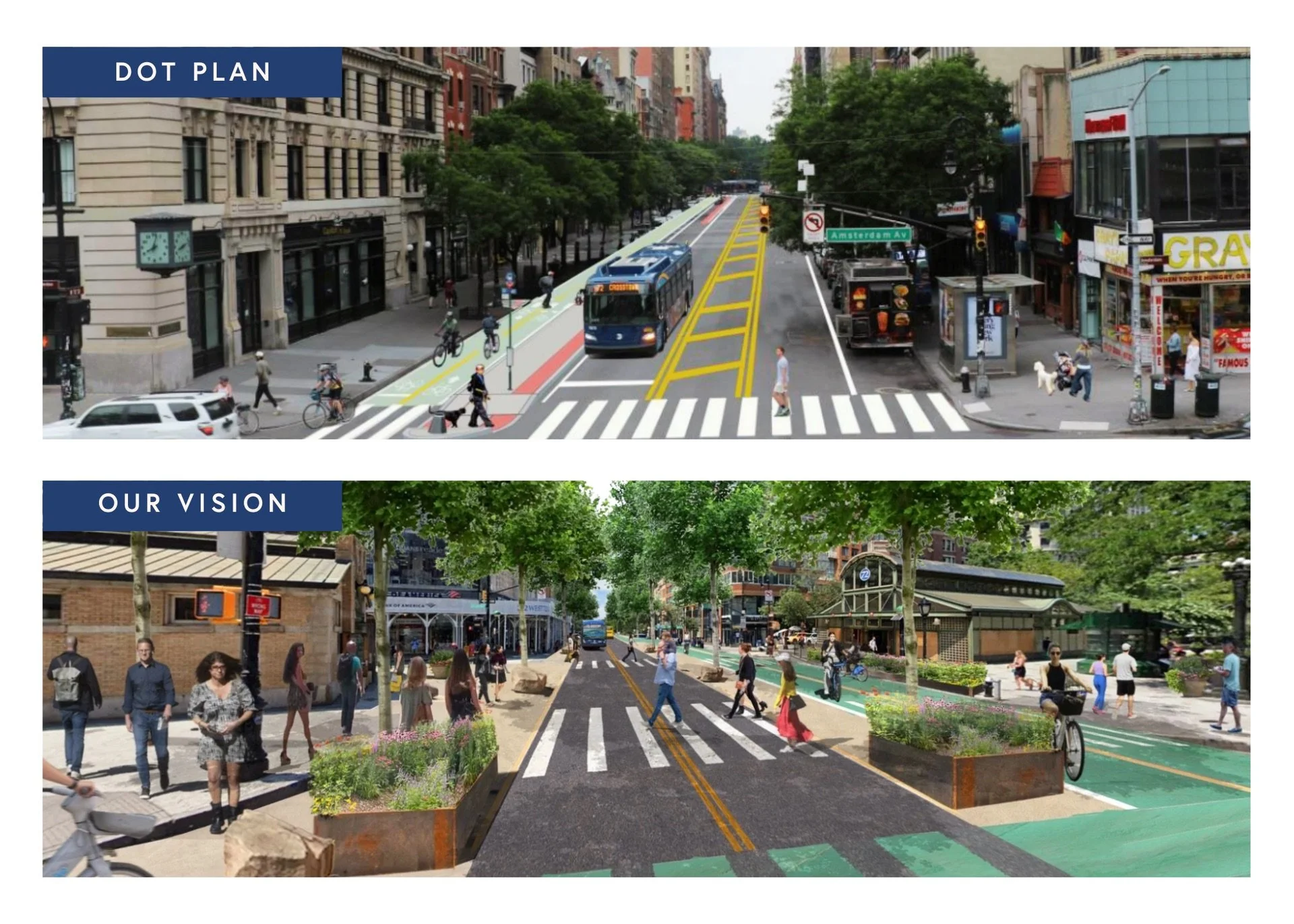
It was good timing, then, that I came across this post on Streetsblog, covering some potential street design changes around Brooklyn’s Grand Army Plaza.  There’s debate over a DOT proposal to remove eastbound parking on Union Street and add a traffic lane, in order to reduce traffic buildup entering the plaza.  Community advocates are concerned that such a proposal won’t solve the fundamental “traffic vortex” problem, and doesn’t take into account the broader goals of creating a more livable and “world class” public space at GAP.

One section by the Grand Army Plaza coalition’s Robert Witherwax stood out to me:

All the tweaks to the plaza, so far, have been consistent with the planning principles GAPCo and its partners have promoted. The problem, says Witherwax, is the city’s piecemeal approach, which the Union Street proposal has cast into sharp relief. “DOT has been an excellent partner,” he said. “It’s not so much that what they have done, or are proposing, is bad — it’s that they aren’t going far enough.”

Witherwax is calling for a “buildable master plan” — a blueprint that would help guide planning and transportation decisions throughout the plaza area according to consistent goals. “Once you have that structure in place, you can say what happens if you do X, Y, and Z over here,” he said. But to date, he added, DOT has resisted the idea of a comprehensive plan.

Perhaps a “living plan” is somewhere in between the current, incremental planning that DOT is practicing an Witherwax’s notion of a “buildable master plan” — something that nurtures the development of guiding principles and longer-term projects, while still allowing for short-term experiments and responsive design.

This whole discussion makes me wonder how technology, in the form of a living plan or otherwise, might inform the debate here.  I can think of a few ways, to start:

  • A website that visualizes competing plans or visions for the future of GAP, where each idea could be discussed, analyzed, and tweaked.
  • An online traffic simulator (for all of Brooklyn?!) that lets anyone make tweaks and see the impacts, in a sim-city sort of way.
  • A tool that explains, via an interactive diagram, the planning process as it’s currently laid out.  Who the decision makers are, where the input points are, and what the schedule is.
  • Anything that generally increase sthe “touchability” of the proposed changes, moving them away from the abstract, wonky world. Perhaps this is something that our friends at the Environmental Simulation Center would be able to help with.
  • (insert your idea here)

<shameless-plugs>
If you dig this kind of thing, head over to the PlanningTech google group and come to one of our upcoming meetups.  If you want to help TOPP and others build tools like these in the near future, check out the (as yet vaporware) Cosm project.
</shameless-plugs>